

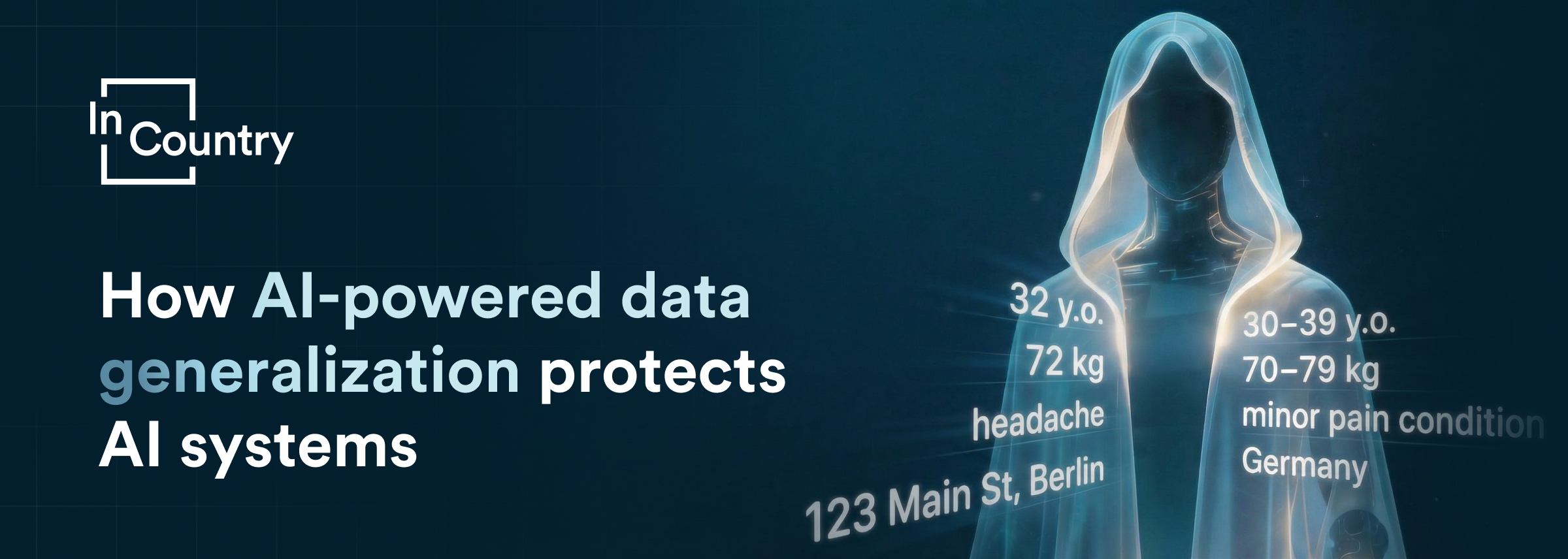
In the age of advanced artificial intelligence, safeguarding personal data is no longer optional; it’s a must. As organizations deploy AI at scale, including large language models (LLMs) and autonomous AI agents, sensitive personal information often flows through AI systems. But AI doesn’t need precise personal values to understand people; it needs context and meaning. That’s where AI-powered data generalization comes in: transforming specific data into semantic categories that preserve context without exposing private details.
In this article, we’ll dive into:
- What data generalization is
- Why it’s essential for AI systems
- How it protects privacy, ensures compliance, and strengthens AI trust
- And how AgentCloak, InCountry’s advanced AI data protection solution, applies generalization in real time to safeguard AI workflows.
What is AI-powered data generalization?
AI-powered data generalization is a sophisticated privacy technique that transforms highly specific personal data into broader, more general categories. Instead of storing or transmitting exact values, systems generalize them based on their semantic meaning.
Examples:
- Age → Age bracket (e.g., “32” becomes “30–39”)
- Weight → Weight bracket (e.g., “72 kg” becomes “70–79 kg”)
- Medical condition → Generalized condition (e.g., “headache” becomes “minor pain condition”)
- Address → Country (e.g., “123 Main St, Berlin” becomes “Germany”)
This preserves enough information for AI systems to make sense of the data while reducing risk and exposure of sensitive values.
Why AI systems don’t need exact personal data
Large language models and AI agents do not require precise identifiers to understand human language. Instead, they rely on:
- Linguistic patterns
- Semantic meaning
- Contextual relationships
- Intent behind user queries
For example, an LLM doesn’t need to know someone’s exact age to provide relevant advice about wellness; knowing the person is in the “30–39 age bracket” provides sufficient context for appropriate output.
By feeding generalized data instead of raw values, AI systems can:
- Maintain accuracy
- Preserve contextual understanding
- Protect individual privacy
- Reduce security exposure
The risks of using raw personal data in AI
Before generalization techniques, training or interacting with AI using raw data posed several dangers:
1. Privacy violations
Sensitive data, such as exact addresses, birth dates, or medical histories, can be inadvertently exposed, especially when AI models are shared or integrated into workflows.
2. Regulatory non-compliance
Global privacy laws such as the GDPR, HIPAA, and emerging AI Acts mandate limits on personal data processing. Generalization directly supports data minimization, a core requirement of these regulations.
3. Data leakage through AI outputs
If an AI model has access to raw personal data, it could regurgitate that information in responses, a risk at odds with enterprise security policies.
Data generalization acts as a safeguard, preventing unnecessary exposure while preserving meaning.
How AI generalization works in practice
Age → Age Bracket
- Raw input: “The user is 32 years old.”
- Generalized data: “The user is in the 30–39 age bracket.”
This still informs the AI about the life stage without revealing the exact age, reducing reidentification risk.
Weight → Weight bracket
- Raw input: “The person weighs 72 kg.”
- Generalized data: “The person is in the 70–79 kg weight bracket.”
Useful for health or fitness AI use cases without leaking biometric specifics.
Medical condition → Generalized condition
- Raw input: “User complains of a severe migraine.”
- Generalized data: “Pain in the head.”
Generalizing clinical detail helps AI provide contextually relevant responses while aligning with privacy safeguards.
Address → Country
- Raw input: “Lives at 123 Main St, Berlin.”
- Generalized data: “The person lives in Germany.”
This gives sufficient location context without street-level detail.
AgentCloak: The next generation of AI data protection
While AI generalization is powerful, applying it consistently and safely at scale requires robust infrastructure. That’s where AgentCloak from InCountry comes in, as a purpose-built solution for AI data protection, privacy compliance, and real-time generalization.
What is AgentCloak?
AgentCloak is an advanced data protection platform that applies AI-powered data generalization, tokenization, hashing, and masking to sensitive information before it reaches AI agents, protecting personal data without breaking context.
It works both ways:
- Cloak sensitive data before AI ingestion
- Uncloaks data (if authorized) when sending results back to the client
This ensures AI models never see or store sensitive values unnecessarily.
Bidirectional cloaking & uncloaking
AgentCloak doesn’t just protect data going into an AI model; it maintains a secure connection between cloaked and uncloaked data using digital twins. When the AI returns results, data can be reinstated only if the user has proper identity context and authorization.
This is critical for enterprise workflows where personalized responses are needed, but privacy must still be guarded.
Identity-driven security
AgentCloak integrates with identity systems to tailor generalization and uncloaking based on user roles and access levels. It ensures:
- Only authorized parties can see uncloaked data
- Sensitive fields remain protected according to compliance policies
This granular control is essential for regulated industries like healthcare and finance.
Cross-border & sovereign AI compliance
Global organizations often face conflicting data residency laws that restrict where information can travel. AgentCloak enables:
- AI agents to operate across borders without transmitting protected data out of their origin country
- Regulatory compliance with laws such as the EU AI Act and China’s PIPL
- Use of localized Sovereign AI models trained on local language and data norms
This means enterprises can deploy AI globally while respecting local privacy and sovereignty requirements.
Seamless integration with AI workflows
AgentCloak supports multiple integration patterns, including:
- MCP Server / Proxy
- A2A Proxy
- Web services APIs
- Real-time agentic flows
This flexibility allows organizations to adopt data generalization and protection without rearchitecting existing systems.
Use cases across industries
Healthcare
- AI-assisted patient triage and symptom checking
- Telehealth assistants
AgentCloak generalizes clinical data to protect privacy while maintaining relevance.
Financial Services
- Customer insights
- Risk analysis
Financial AI tools can operate without exposing exact account numbers or personal identifiers.
Enterprise Agents & Copilots
- Internal AI chatbots
- Employee support agents
Generalization ensures internal workflows remain compliant while benefiting from AI assistance.
Global Customer Support
- Cross-border AI for multilingual support
AgentCloak’s Sovereign AI compliance ensures data stays within jurisdiction while enabling consistent AI experiences worldwide.
Generalization protects AI and AgentCloak makes it enterprise-ready
AI adoption is skyrocketing across industries, but so are the expectations for privacy, trust, and regulatory compliance. AI-powered data generalization is essential because:
- It preserves contextual understanding without exposing sensitive data.
- It ensures AI systems remain effective and secure.
- It simplifies compliance with global data laws and AI regulations.
And with InCountry’s AgentCloak, organizations can implement real-time, identity-aware data generalization, ensuring AI systems operate safely and compliantly across borders and use cases.
Whether deploying conversational AI, enterprise agents, or global customer support workflows, AgentCloak helps companies unlock AI’s full power without sacrificing privacy or compliance.