

For years, Salesforce to Salesforce has been an excellent solution to synchronize record across different Salesforce orgs. Salesforce recently announced that Salesforce to Salesforce is scheduled for retirement in February 2027. Customers have a year to switch to a new solution, and Salesforce is recommending using the Mulesoft ETL platform. Unfortunately, Mulesoft doesn’t use realtime triggers, is cumbersome, and adds significant additional expense.
InCountry’s proven and cost-effective Org to Org (O2O) solution uses triggers to efficiently transmit data between Salesforce orgs. InCountry Org to Org also includes cross-border governance capabilities that optionally cloaks data that is transmitted across jurisdictions, such as a regional Salesforce org in the EU syncing data to a global Salesforce org in the US. Syncing the data maintains global pipeline reporting, and cloaking prospect personal information reduces the compliance burden.
What is Salesforce to Salesforce (S2S) and why is it being retired?
S2S was Salesforce’s built-in feature for sharing records between two Salesforce orgs. It allowed basic object and field sharing, enabling two partners or business units to subscribe to records published by each other. But despite its early utility, Salesforce is now moving away from this legacy capability. Salesforce officially plans to retire S2S in February 2027, signaling that the feature will no longer receive support or updates beyond that date.
This retirement reflects two broader trends, Salesforce’s broader shift to unified, platform-wide tools and APIs, and the decline of legacy, Classic-dependent functionality in favor of modern, scalable methods
S2S served its purpose for simple sharing use cases, but it was not built for regulated environments, cross-border governance, or condition-based data control, which are now essential for global enterprises.
S2S being on the retirement roadmap means:
- There will be no future feature development
- Organizations must plan their migration strategy
- Dependence on a deprecated feature creates long-term technical risk
Even if an org continues to use S2S until 2027, the absence of condition filtering, scheduling, and compliance controls means it will increasingly fall short, especially for regulated enterprises.
InCountry Org to Org: A modern Salesforce sync solution
InCountry O2O is part of a purpose-built data residency and sovereignty platform that enables cross-system synchronization, including CRM to CRM, while aligning with strict data governance policies.
While S2S was designed for generic record sharing, SXB focuses on controlled, compliant synchronization that respects:
- Data residency requirements
- Cross-jurisdiction governance policies
- Conditional migration logic
- One-time or scheduled filtered updates
This makes SXB a strong alternative, not just functionally, but strategically, for organizations facing evolving privacy and sovereignty regulations.
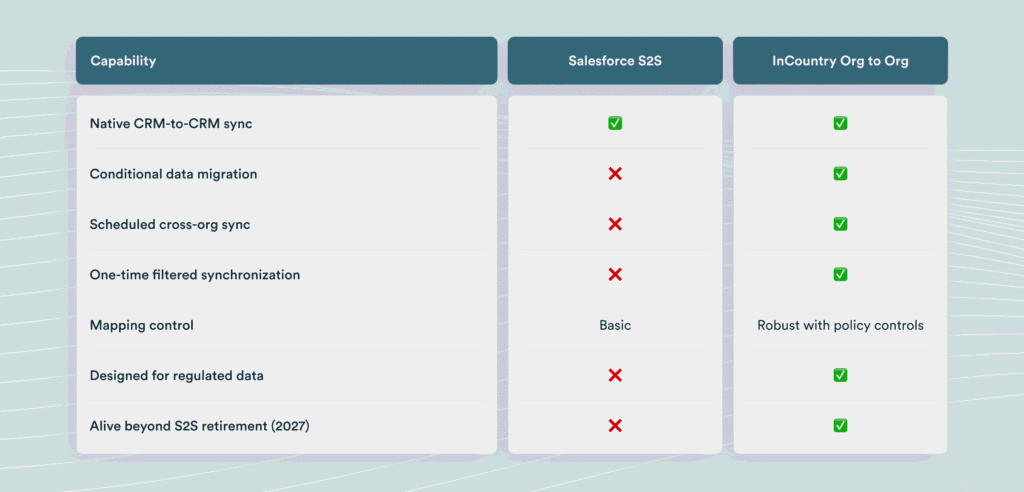
Head-to-head: Salesforce S2S vs Org to Org
Key InCountry O2O features that exceed S2S
1. Conditional and scheduled migrations
S2S only shares records based on subscription settings; there’s no way to schedule migrations or filter based on business logic or compliance rules.
InCountry O2O supports condition-based sync, allowing teams to schedule or trigger migrations for records that meet specific conditions (e.g., region, regulatory classification, date ranges). This flexibility is invaluable for compliance and governance.
2. Cross-border compliance
S2S doesn’t address where data is stored, whether datasets cross legal boundaries, or how syncing aligns with local regulations.
In contrast, SXB sits within a broader compliance platform that helps enforce data residency and sovereignty policies, making it suitable for global enterprises dealing with GDPR, CCPA-style laws, or country-specific mandates.
3. Legacy feature sunset
With Salesforce phasing out S2S by 2027, organizations that depend on it must either migrate to successor tools or adopt third-party solutions or risk losing native functionality altogether.
InCountry SXB is designed as a forward-looking alternative, ready now with modern policy controls and without the constraints of legacy architecture.
Why InCountry O2O is the strategic and compliant choice for 2026 and beyond
Enterprises today must balance operational efficiency with data compliance and sovereignty. InCountry O2O aligns with that reality:
- Future-ready sync
As Salesforce retires S2S, SXB continues to provide CRM synchronization that can operate at scale.
- Policy-driven controls
Admins can define rules, schedules, and filters that matter for compliance and business logic.
- Built-in data residency
SXB is part of a platform explicitly designed to handle data storage and movement rules by jurisdiction.
- Compliance-first architecture
In regulated industries, the ability to enforce conditional logic and to schedule filtered migrations is essential and beyond the capabilities of S2S both today and tomorrow.
With Salesforce retiring its native Salesforce to Salesforce (S2S) feature, organizations that need meaningful CRM data synchronization should rethink their approach.
While S2S provided basic record sharing in the past, it lacks the modern governance, scheduling, and compliance logic required in today’s data-conscious world and its sunset means that reliance on it is increasingly risky.
InCountry O2O is a strong alternative because it’s built for the future: supporting conditional migrations, respecting jurisdictional data laws, and enabling enterprises to maintain control over CRM data flows long after Salesforce’s legacy sync is gone.