


The European Union has approved important amendments to the EU AI Act that will significantly impact enterprise AI compliance timelines. The Council of the European Union has endorsed changes that postpone several deadlines for high-risk AI systems while also introducing new prohibited AI practices and clarifying regulatory responsibilities.
Although the legislative act still needs to be published in the Official Journal of the European Union before taking effect, organizations developing, deploying, or operating AI systems should begin preparing now. These changes provide additional implementation time, but they do not reduce the long-term compliance obligations.
Here’s what enterprises need to know.
The biggest change: High-risk AI compliance deadlines have been extended
One of the most significant outcomes of the latest amendments is the extension of implementation deadlines for high-risk AI systems.
The revised timeline gives organizations additional time to prepare for compliance:
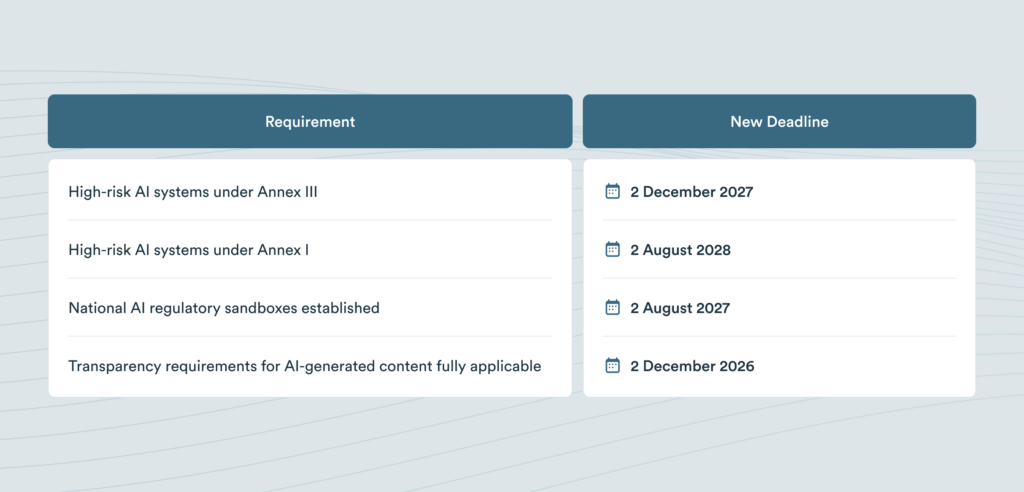
For many enterprises, particularly those operating across regulated industries, the postponement offers valuable breathing room to implement governance frameworks, conduct risk assessments, and update AI systems.
However, organizations should avoid interpreting these extensions as an opportunity to delay preparation. AI governance programs often require months or even years, to implement effectively, especially for multinational enterprises subject to multiple regulatory frameworks.
New AI systems are now explicitly prohibited
The amendments also introduce a new prohibited AI practice targeting one of the fastest-growing areas of AI misuse.
Beginning in December 2026, AI systems will be prohibited from generating:
- Non-consensual intimate or sexual content
- AI-generated nude images of real individuals
- Systems that digitally remove clothing from existing photographs
- Child sexual abuse material (CSAM)
These prohibitions reflect increasing concerns around generative AI abuse and synthetic media. Organizations developing foundation models, image generation tools, or consumer AI applications should review their safety mechanisms and content moderation controls well before enforcement begins.
AI office responsibilities are now more clearly defined
Another notable update concerns the role of the European AI Office.
The revised legislation clarifies that the AI Office will supervise AI systems built on general-purpose AI (GPAI) models when both the model and the downstream system are developed by the same provider.
At the same time, several important sectors remain under national authority, including:
- Law enforcement
- Border management
- Judicial authorities
- Financial institutions
This clarification should reduce regulatory uncertainty for providers of foundation models while preserving sector-specific oversight where specialized expertise is required.
Better alignment between the AI Act and existing sector regulations
Many industries already operate under strict product safety and regulatory frameworks.
For AI systems listed under Annex I, including products regulated as:
- Medical devices
- Toys
- Machinery
- Watercraft
- Elevators and lifts
- Other regulated industrial products
the updated legislation limits duplicate regulatory obligations when existing sectoral regulations already impose AI-specific requirements equivalent to those found in the AI Act.
This change aims to reduce unnecessary overlap while maintaining high safety standards.
For manufacturers and technology providers operating in regulated industries, this should simplify compliance planning and reduce duplicate assessments.
Machinery products receive an important exemption
The amendments also introduce a significant change for machinery manufacturers.
Products governed under the EU Machinery Regulation that were previously considered high-risk AI systems under Annex I will no longer be directly subject to portions of the AI Act.
Instead, the European Commission may introduce additional health and safety requirements through secondary legislation under the Machinery Regulation itself.
This creates a more consistent regulatory approach by avoiding parallel compliance processes for the same product.
The EU commission must help reduce compliance burden
Recognizing the complexity of AI regulation, the updated legislation also places a new obligation on the European Commission.
The Commission must now develop guidance that helps economic operators of Annex I high-risk AI systems comply with the AI Act while minimizing unnecessary compliance burdens.
This guidance is expected to become particularly valuable for organizations navigating overlapping requirements across:
- Product safety regulations
- Medical device legislation
- Machinery regulations
- AI governance obligations
For many enterprises, practical implementation guidance may prove just as valuable as the legislative changes themselves.
What these changes mean for enterprise AI compliance
Although the deadlines have shifted, organizations should view this period as an opportunity not a pause.
Successful AI compliance requires much more than documenting models before enforcement begins. Enterprises should continue building governance capabilities now, including:
- AI inventory and classification
- Sensitive data discovery
- Risk assessments
- Human oversight processes
- Documentation and audit readiness
- Monitoring of AI outputs
- Data residency and privacy controls
- Vendor AI governance
Organizations deploying generative AI across regulated industries will also need to demonstrate transparency, accountability, and strong controls over sensitive data.
Why data governance remains critical under the EU AI Act
One of the biggest compliance challenges isn’t simply identifying which AI systems qualify as high-risk, it’s understanding what data those systems process.
Many enterprise AI deployments access:
- Personally identifiable information (PII)
- Protected health information (PHI)
- Financial records
- Customer communications
- Internal intellectual property
Without automated controls, organizations may struggle to comply with both the AI Act and existing regulations such as the GDPR, sector-specific requirements, and national data residency laws.
Solutions that automatically detect, classify, redact, tokenize, or localize sensitive information before it reaches AI models can significantly reduce compliance risk while enabling broader AI adoption.
For global enterprises, data governance is becoming a foundational component of responsible AI rather than simply a privacy requirement.
How InCountry helps organizations prepare
As AI regulation continues to evolve, enterprises need infrastructure that enables innovation without compromising compliance.
InCountry helps organizations deploy AI while maintaining control over sensitive and regulated data through capabilities including:
- Data residency and sovereignty controls
- Automated PII, PHI, and PCI detection
- Sensitive data redaction and tokenization
- Secure AI data processing
- Support for global regulatory compliance
- Protection of enterprise AI workloads through AgentCloak
By ensuring sensitive information remains protected before interacting with AI systems, organizations can accelerate AI adoption while reducing regulatory risk under evolving frameworks like the EU AI Act.
The latest EU AI Act amendments provide organizations with additional time to prepare for compliance, but they also reinforce the EU’s commitment to responsible AI governance.
With new prohibited AI practices, clarified regulatory responsibilities, and revised compliance timelines, enterprises should use this extended implementation window to strengthen AI governance, modernize data protection strategies, and prepare for the next phase of AI regulation.
The amendments will become legally effective once the legislative act is published in the Official Journal of the European Union, entering into force three days after publication. Until then, organizations should monitor developments closely and continue building compliance programs that are designed to scale alongside rapidly evolving AI regulations.


